The 1990s mid-to-late 1990s
Cargo Pants
Loose military trousers with big bellows pockets on the thighs - adopted by skaters, ravers and hip-hop fans, then by pop stars in low-rise versions, and one of the most-worn trousers of the late decade.
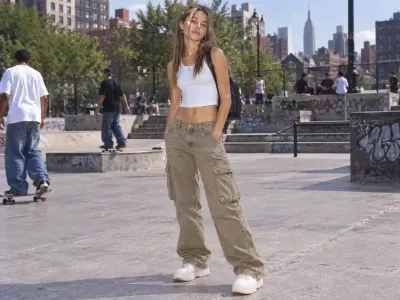
Cargo pants are trousers with large patch pockets on the outside of the thighs, usually "bellows" pockets that expand with pleats and close with a flap. They started as military clothing and became one of the most popular trousers of the late 1990s, worn by nearly every youth group of the decade.
Their origin is practical. Soldiers need to carry maps, ammunition, and equipment, and pockets on the thigh are easy to reach even when crouching or kneeling. The British Army introduced trousers with a large thigh pocket as part of its battledress uniform in the late 1930s, and American paratroopers in the Second World War wore trousers with big cargo pockets. After the war, military-surplus cargo trousers became cheap, hard-wearing casual wear.
In the 1990s, several groups took them up at once. Skateboarders liked their toughness and loose fit. Ravers wore them because they were comfortable for dancing all night and had room for everything they needed, as the rave culture entry explains. And they fitted perfectly into the baggy hip-hop silhouette. Cargo pants came in cotton twill, ripstop, and camouflage, and increasingly in technical, synthetic fabrics, in khaki, olive, black, grey, and bright colours.
For women, cargo pants became a key part of the late-1990s look. Pop stars, including the Spice Girls, wore them with cropped tops and platform trainers, and they were one of the core pieces of the Y2K silhouette. The women's versions were often slimmer and low-rise, sitting on the hips with a bare midriff above, which gave a utilitarian garment a sexy, playful edge.
I like cargo pants as a symbol of the decade's love of utility. They are practical, tough, and comfortable, and they carry an air of adventure and military toughness, but in the late 1990s they were worn for dancing and hanging out rather than for combat. They've also come back strongly in recent years, which says a lot about how much of the late 1990s wardrobe still appeals.