The 1990s mid-to-late 1990s
The Low-Rise Waistband
Trousers and skirts cut with a short rise so the waistband sits on the hips, not the waist - launched by Alexander McQueen's shocking 'bumsters' in 1993, sexed up by Tom Ford's velvet hipsters, and everywhere by the end of the decade.
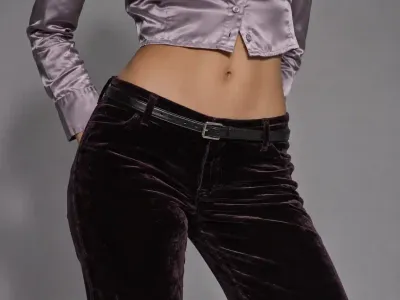
Waistlines have moved up and down throughout fashion history, and this site follows them closely - from the 1930s return of the natural waist to the high-waisted jeans of the 1970s and 1980s. In the 1990s, the waistline of trousers and skirts began to drop below the natural waist onto the hips, and by the end of the decade low-rise was everywhere.
In pattern-cutting terms, the key measurement is the rise: the distance from the crotch seam up to the top of the waistband. A high-rise trouser has a long rise that reaches the natural waist or above; a low-rise trouser has a short rise, so the waistband sits several inches lower, on or below the hip bones. That changes the whole construction. Because the hips are wider than the waist, the waistband of a low-rise garment has to be shaped to curve around the hips rather than cinch in at the waist, and it's often cut as a contoured band rather than a straight strip. There's less fabric above the crotch, and the fit depends much more on the hips and seat.
The designer usually credited with starting the trend is Alexander McQueen. In his early collections from 1993, he showed "bumster" trousers and skirts cut so low at the back that they revealed the top of the buttocks. They were provocative and extreme, and McQueen said he wanted to change the way the body looked by lengthening the torso. The bumster itself was never a mass fashion, but it pointed the way. Tom Ford's velvet hipster trousers for Gucci in 1995 made a sleeker, sexier low-slung look desirable, and low-rise jeans, trousers, and skirts spread through the late 1990s.
By the end of the decade, low-rise was a key part of the Y2K silhouette, worn with cropped tops that showed the midriff and cargo pants that sat on the hips. It reached its most extreme point in the early 2000s. It's worth distinguishing from the sagging trousers of hip-hop, which were loose trousers worn pulled low rather than cut low.
For home sewists, the low-rise waistband is a reminder of how much a single measurement can change a garment. Shorten the rise by a few inches and you get a completely different silhouette, fit, and attitude - which is exactly what happened in the 1990s.