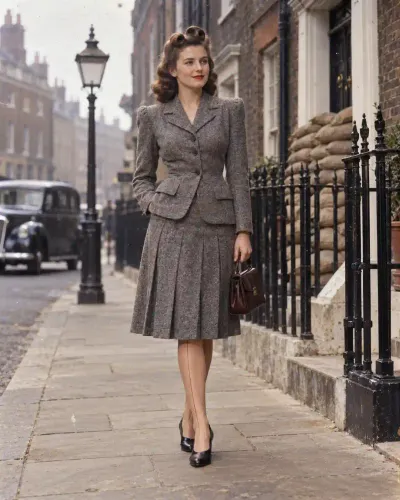
The 1940s
1940–1949
Coupons, square shoulders, and make-do-and-mend - a decade dressed by war rationing, right up until Dior's New Look tore up the rulebook in 1947.
Silhouettes
-
The Draped Evening Silhouette
Long, fluid, body-skimming evening gowns shaped by draping and pleating rather than boning - the decade's glamour line, kept alive by Paris couturiers and Hollywood costume departments alike.
-
The Postwar Softening Silhouette
The late-decade move from squared utility shoulders to sloping shoulders, longer skirts, and a cinched waist - the slow build-up to, and messy aftermath of, Dior's 1947 New Look.
-
The Slacks Silhouette
High-waisted, wide-legged trousers worn with a tucked-in blouse or sweater - the silhouette that moved women's trousers from Hollywood novelty to everyday working wardrobe.
-
The Sweater Girl Silhouette
A close-fitting knit sweater over a structured, pointed bra and a high-waisted skirt - Hollywood's pin-up silhouette, built almost entirely on what was worn underneath.
-
The Utility Silhouette
Squared, padded shoulders over a narrow waist and a short, slim skirt stopping just below the knee - the defining wartime shape, and one dictated as much by fabric regulations as by taste.
Designers
-
Adrian
MGM's star costume designer, who left the studio in 1941 to open his own Beverly Hills salon - taking Joan Crawford's famous padded shoulders with him into American ready-to-wear.
-
Bonnie Cashin
The Californian designer who spent the war years dressing films at 20th Century Fox, then came back to New York in 1949 with the practical, layered, travel-ready ideas that would make her a founder of American sportswear.
-
Claire McCardell
The American designer who used wartime restrictions as a design brief - the Popover dress, ballet flats for the street, and the practical, mass-produced sportswear that became the 'American Look.'
-
Lucien Lelong
The couturier who, as head of the Paris couture trade body, talked the German occupiers out of moving French fashion to Berlin - and whose house trained both Christian Dior and Pierre Balmain during the war.
-
Madame Grès
The Paris couturière whose hand-pleated silk jersey gowns turned draping into sculpture - and who openly defied the occupiers, showing a collection in the colours of the French flag.
-
Norman Hartnell
The royal dressmaker who helped design Britain's government-backed Utility clothing in 1942 - and then made Princess Elizabeth's 1947 wedding dress, paid for partly with clothing coupons.
-
Pierre Balmain
Trained at Molyneux and then at Lucien Lelong alongside Christian Dior, Balmain opened his own house in 1945 - and his debut collection of long, bell-shaped skirts got to the postwar silhouette more than a year before the New Look.
Garments
-
The Bobby-Soxer Look
Folded-down ankle socks, saddle shoes or loafers, a pleated skirt and an oversized 'sloppy joe' sweater - the uniform of the teenage girls who screamed for Sinatra, and one of the first real teenage fashion looks.
-
The Dirndl Skirt
A full skirt gathered onto a waistband, borrowed from Alpine folk dress - a pre-war craze squeezed small by wartime fabric rules, still sewn at home from remnants, then let loose again in the years after 1945.
-
The Eisenhower Jacket
A short, waist-length military jacket with a fitted band at the waist, adopted by the US Army in 1944 and named after its most famous wearer - and one of the clearest routes by which uniform shapes crossed into postwar women's clothes.
-
The Peplum Jacket
A fitted jacket with a short flared frill below the waist - a small detail that made a waist look smaller under square wartime shoulders, then grew fuller and rounder as the decade turned toward the New Look.
-
The Playsuit
Shorts and a top, often in one piece, sometimes with a button-on skirt - the practical summer leisure outfit of the 1940s, for gardens, beaches, bicycles and the 'holidays at home' of the war years.
-
The Siren Suit
A one-piece, zip-front boiler suit designed to be pulled on over nightclothes when the air-raid siren sounded - a wartime practicality that briefly became genuine fashion.
-
The Snood
A net or crocheted bag holding long hair at the nape of the neck - a Victorian idea revived just before the war, and one of the easiest pieces of 1940s fashion to make at home.
-
The Sweetheart-Neckline Evening Gown
A heart-shaped neckline above a fitted bodice and a long, softly falling skirt - the romantic dance dress of the war years, worn to forces dances and weddings when most other clothes had turned plain and practical.
-
The Tea Dress
A knee-length day dress in printed rayon crepe, with gathered shoulders, a V or sweetheart neckline, and a gently flared skirt - the decade's everyday dress, and its most copied one today.
-
The Turban and Headscarf
A length of fabric wrapped and knotted around the head - factory safety gear, a disguise for unwashed hair, and in occupied Paris, an act of quiet defiance.
-
The Utility Suit
A single-breasted jacket and knee-length skirt, cut to government fabric limits and carrying Britain's CC41 label - the wartime suit that proved rationed clothes could still be well designed.
-
The Wedge Shoe
A shoe with a solid sole running from heel to toe, often in cork or wood - born of material shortages, and one of the decade's most widely worn shoe shapes.
-
Wartime Lingerie and Utility Underwear
Knickers, slips and petticoats on the ration - plain utility underwear without embroidery, rayon locknit instead of silk, service-issue knickers nicknamed 'passion killers', and a great deal of homemade lingerie cut from whatever fabric came to hand.
Fabrics & Textiles
-
Feedsack Cotton
Printed cotton sacks for flour, sugar, and animal feed, designed to be turned into dresses, aprons, and children's clothes once emptied - the fabric of rural and working-class home sewing.
-
Gabardine
A tightly woven, hard-wearing twill with a steep diagonal rib - claimed first by uniforms and raincoats during the war, and the fabric of choice for 1940s slacks and suits in both wool and rayon.
-
Nylon and the Stocking Shortage
DuPont's new wonder fibre launched as women's stockings in 1940, vanished into parachutes by 1942, and came back in 1945-46 to literal riots - with painted-on 'stockings' filling the gap in between.
-
Parachute Silk
Surplus and salvaged parachutes, in silk or nylon, recut into wedding dresses, lingerie, and blouses - the decade's most romantic example of making do.
-
Propaganda Prints
Scarves and dress fabrics printed with wartime slogans, flags, and patriotic motifs - most famously the London silk house Jacqmar's propaganda scarves - turning morale into something you could wear.
-
Rayon
The regenerated-cellulose fibre that stood in for silk and much of wool during the war - the fabric the decade's tea dresses, blouses, and linings were actually made from.
Construction & Fit
-
Button and Zipper Shortages
With metal diverted to the war effort, zippers became scarce and button counts were capped - pushing garment closures back toward snaps, hooks, side plackets, and buttons in wood, glass, and plastic.
-
Make Do and Mend: Remaking and Refashioning
The home techniques - unpicking, turning, re-cutting, darning, and reknitting - that kept wartime wardrobes going, and turned a husband's old suit into his wife's new one.
-
Shoulder Pads and the Square Shoulder
Padding sewn into jackets, coats, dresses, and even blouses to build a broad, squared shoulder line - the construction detail that carried the decade's whole silhouette.
-
The Girdle and the Rubber Shortage
When Japan's advance in 1942 cut the Allies off from most of their natural rubber, elastic all but vanished from civilian foundation garments - and girdles went back to lacing, boning, hooks, and clever cutting.
-
The Wartime Bra and the Stitched Cup
How the 1940s bra got from the soft, sized cups of the 1930s to the projecting, circle-stitched shape of the 1950s - built from seaming and stitching rather than wire or stretch, because the war had taken both.
-
Utility and L-85: Designing to Regulation
Britain's Utility scheme and America's L-85 order set legal limits on fabric, pleats, pockets, trims, and hem widths - effectively a government-issued construction rulebook for a whole decade's clothes.
Culture & Context
-
Clothes Rationing and Coupons
From June 1941 every item of clothing in Britain cost coupons as well as money, on an allowance that shrank as the war went on - the system that shaped how a whole generation of women shopped, sewed, and dressed.
-
Paris Under Occupation
Four years of German occupation cut Paris off from the rest of the fashion world - couture survived, for a fraught clientele, while ordinary Parisiennes answered shortages with towering hats, wooden soles, and a streak of defiance.
-
Rosie the Riveter and War Work
Millions of women moved into factories, shipyards, and the services during the war - bringing overalls, trousers, headscarves, and practical hair into everyday life, and a famous poster that almost nobody saw at the time.
-
The Rise of American Fashion
With Paris cut off from 1940, American stores, editors, and designers had to stand on their own for the first time - and the result was the 'American Look,' Press Week, and the start of New York as a fashion capital.
-
The Théâtre de la Mode
In 1945, with fabric still scarce, the Paris couture houses dressed more than two hundred wire dolls in miniature couture and sent them touring - a fundraiser that doubled as Paris announcing it was back.
-
The Zoot Suit and Pachuca Style
A deliberately excessive youth style born in Black and Latino communities, worn by young women as well as men, that ran straight into wartime fabric restrictions - and into the 1943 Zoot Suit Riots in Los Angeles.