The 1940s throughout the 1940s
The Wartime Bra and the Stitched Cup
How the 1940s bra got from the soft, sized cups of the 1930s to the projecting, circle-stitched shape of the 1950s - built from seaming and stitching rather than wire or stretch, because the war had taken both.
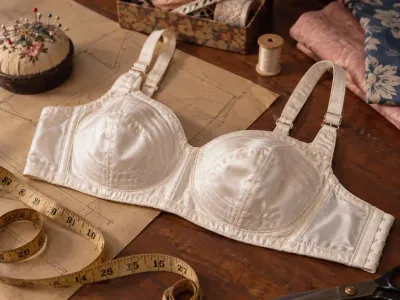
The 1930s gave us the bra with sized cups; the 1950s gave us the pointed bullet bra. The 1940s are the decade in between, and I think they're where the real engineering happened - under wartime shortages that ruled out most of the obvious solutions.
The fashionable shape moved steadily upward and forward. The broad-shouldered wartime silhouette and the fitted knits of the sweater girl look both called for a high, lifted, clearly defined bust, very different from the softer, lower line of the 1930s. The question was how to build it.
The easy answers weren't available. Steel was needed for the war, so metal underwires - which had been patented in the 1930s - were not a practical option for most civilian bras. Elastic was scarce because of the rubber shortage, so bands and straps had to rely on woven fabric, hooks, and adjustable fastenings rather than stretch. So the shaping had to come from the cut and the stitching itself. Cups were made from several pieces seamed together to create depth, and increasingly they were reinforced with rows of stitching - sometimes straight, sometimes in circles or spirals - which stiffened the fabric and held it in a projecting shape. Satin, rayon, and cotton broadcloth were typical fabrics.
That circular stitching is the key to what came next. Stitched, cone-shaped cups developed through the 1940s, and in 1949 the American company Maidenform introduced its "Chansonette," a bra with spiral-stitched conical cups that had sold more than 90 million by the late 1970s, making it one of the best-selling bras of all time and the classic example of the bullet bra. The postwar fashion for a nipped waist and full bust, seen in the postwar softening, only increased the demand for that shape.
There was also a practical side. Women doing heavy war work needed support to be comfortable, and the foundation industry argued, in its advertising and in lobbying for scarce materials, that a good bra and girdle were part of keeping women fit for work. I find it satisfying to see how a shortage-driven technique - stitching instead of wire and elastic - became the defining look of the following decade. The 1950s bullet bra wasn't a sudden invention; it was the 1940s solution, pushed as far as it would go.