The 1940s late 1940s
The Eisenhower Jacket
A short, waist-length military jacket with a fitted band at the waist, adopted by the US Army in 1944 and named after its most famous wearer - and one of the clearest routes by which uniform shapes crossed into postwar women's clothes.
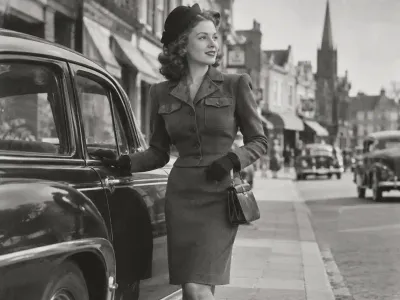
The 1940s silhouette borrowed a great deal from uniforms, and the utility silhouette entry covers that in general terms. The Eisenhower jacket is one specific garment that shows how directly the borrowing could happen.
The jacket was a short, waist-length wool jacket, fitted at the waist with a band or belt, with shaped shoulders, patch or flap pockets on the chest, and a concealed or buttoned front. Its ancestor was the British Army's battledress blouse, a practical short jacket designed so that nothing hung below the waist to catch on equipment. General Dwight D. Eisenhower, the Allied commander in Europe, wore a tailored, shortened jacket of this kind, and when the US Army adopted a similar design as a standard wool field jacket in 1944, it became known as the "Ike" or Eisenhower jacket. It was smart, practical, and, thanks to its famous wearer, instantly recognisable.
Women's services had their own versions, and after the war, the shape crossed easily into civilian fashion. A short, belted jacket that ended at the natural waist was very flattering over a slim or gently flared skirt, and it emphasised the waist in a way that fitted the move toward the postwar softening. Women wore cropped, waist-length jackets with skirts and with slacks, in wool, gabardine, and later in suede and leather. Many returning servicemen's jackets were also simply worn, altered, or remade by the women in their families - a very make-do-and-mend route into fashion.
I find the Eisenhower jacket interesting because it's a direct line between the military and the high street. The idea of a short, neat, belted jacket carried on well beyond the 1940s, in the bomber and blouson jackets of later decades, and it's still a staple today. It's also a reminder of how many women in these years had worn uniform themselves, in the services or in war work, and found its practical, confident lines worth keeping.