The 1940s throughout the 1940s
Gabardine
A tightly woven, hard-wearing twill with a steep diagonal rib - claimed first by uniforms and raincoats during the war, and the fabric of choice for 1940s slacks and suits in both wool and rayon.
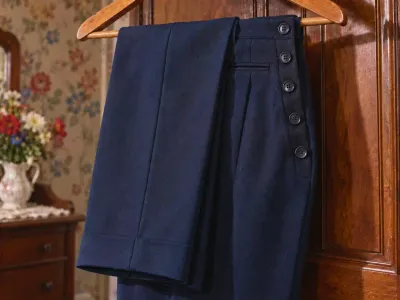
If I had to pick one fabric for a pair of 1940s trousers, it would be gabardine. It's the cloth of pressed front creases, crisp tailored suits, and good raincoats, and it was everywhere in this decade - partly because it was so useful, and partly because the war wanted a great deal of it.
Gabardine is a twill weave, which means the threads are woven in a pattern that creates diagonal lines across the fabric. In gabardine, those lines are fine, close together, and steep, and the cloth is woven very tightly. That gives it a smooth, hard face, a slight sheen, and real toughness. It holds a crease beautifully, it resists wind and rain, and it doesn't wrinkle easily. The version we know today goes back to Thomas Burberry, who developed a weatherproofed gabardine in the late 1870s; it became the fabric of the trench coat in the First World War.
In the 1940s, that toughness made it a military fabric first. Wool was needed in huge quantities for uniforms and greatcoats, and fine wool gabardine was used for officers' uniforms, while civilian wool supplies were squeezed in both Britain and the US. That's one reason rayon gabardine became so common for civilian clothes: it had the same smooth twill look and good drape, cost less, and was more available. Plenty of 1940s women's slacks, utility suits, and skirts were made in rayon or wool-and-rayon gabardine, in navy, brown, grey, and wartime shades of green and tan.
What I like about gabardine is how well it suited the practical mood of the decade. The utility silhouette depended on clean lines and crisp tailoring with very little decoration, and gabardine made that minimal look sharp rather than plain. It also lasted, which mattered when clothing was rationed and a suit had to earn its coupons over years of wear. After the war, gabardine stayed popular for trousers, suits, and raincoats well into the 1950s. It's still easy to find today, and it's one of the fabrics I'd recommend to anyone making a 1940s reproduction: if the trousers need to hang straight and hold a knife-edge crease, gabardine is the answer.