The 1990s mid-1990s
The Slip Dress
A simple bias-cut dress on thin straps, borrowed straight from 1930s lingerie - the decade's defining dress, worn minimal and bare by Kate Moss, over a T-shirt by grunge kids, and as a wedding gown by Carolyn Bessette.
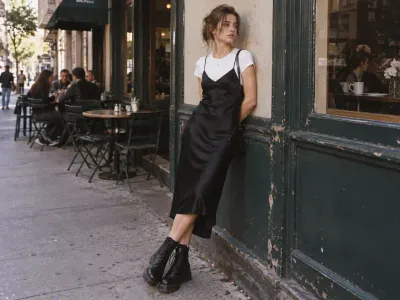
If one dress sums up the 1990s, it's the slip dress. It's almost nothing: a simple, loose-fitting dress on thin spaghetti straps, usually cut on the bias in satin, silk, or a slippery synthetic, falling straight to the knee, calf, or ankle. And yet it managed to belong to nearly every style of the decade at once.
Its shape comes directly from underwear. The 1930s bias-cut slip was designed to go under a clinging dress, and some 1930s evening gowns already looked like long slips. In the 1990s, the slip came out from underneath and became the dress itself. That was part of a wider idea of underwear as outerwear, which Gaultier's corsets had pushed in the 1980s, but the 1990s version was quieter and more minimal: not a statement corset but a soft, simple dress.
Designers including Calvin Klein, John Galliano, and many others made slip dresses in the early and mid-1990s, and they became hugely popular across every price level. The most famous single image came in 1993, when Kate Moss wore a silvery, semi-sheer Liza Bruce slip dress to a model-agency party in London, photographed so that it was almost completely see-through - a picture that summed up the waif look and the decade's fascination with sheer fabrics. And in 1996, Carolyn Bessette married John F. Kennedy Jr. in a plain, bias-cut silk slip dress by Narciso Rodriguez, which made the style the height of minimalist elegance.
What I love about the slip dress is how differently it could be worn. Minimalists wore it alone with flat sandals or a simple jacket. Grunge fans wore it over a T-shirt with a cardigan and Dr. Martens, turning something delicate into something tough. In velvet or satin, it was eveningwear; in a floral print, it was a summer day dress. Television characters wore it too, which helped spread it to the high street.
It's also one of the most enduring garments the decade produced. The slip dress has barely left fashion since, and it's a lovely thing to sew: a bias-cut slip is a real lesson in how fabric grain shapes the way a garment hangs and moves.