The 1950s mid-to-late 1950s
The Ballet Flat
A soft, heelless slipper-style shoe adapted from the dancer's pump - brought onto the street by Claire McCardell and Capezio in the 1940s, and made chic in the 1950s by Audrey Hepburn and Brigitte Bardot.
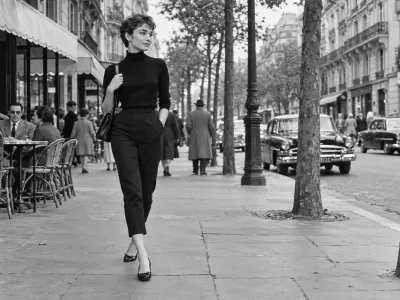
The 1950s is often pictured as a high-heeled decade, and the stiletto really was its most dramatic shoe. But one of its most influential shoes had no heel at all. The ballet flat - a soft, low-cut, slipper-like shoe with a thin sole, often with a small bow at the front - went from dance studio to street in these years, and it has never really left.
Its fashion story begins in the 1940s with Claire McCardell, who in the early 1940s worked with the dancewear company Capezio to produce ballet-style slippers for everyday wear with her sportswear, partly because of wartime shortages and the rationing of street shoes. The idea fitted her whole philosophy of comfortable, practical clothes for active women. But it was in the 1950s that ballet flats became a genuine fashion, and two film stars did a great deal to make them glamorous.
The first was Audrey Hepburn, whose gamine, slim, understated style - slim trousers, fitted black tops, and flat shoes - appeared in films like Funny Face (1957), and she became one of the most copied style icons of the decade. The second was Brigitte Bardot. In 1956 the French dancewear maker Rose Repetto created a red ballet-style shoe for her, which she wore in the film And God Created Woman, and the style, known as the "Cendrillon," became hugely famous. Ballet flats also fitted the beatnik look, with its black tights and turtlenecks, and the youthful casual wardrobe of capri pants and pedal pushers.
What I like about the ballet flat is that it offered a completely different kind of femininity from the stiletto. Where the stiletto was sexy, sophisticated, and a little dangerous, the ballet flat was youthful, graceful, and easy, suggesting a dancer's lightness rather than a pin-up's curves. That made it especially popular with younger women, and it pointed toward the more relaxed, youthful fashion of the 1960s. It's also one of the most enduring shoes of the twentieth century - a very simple design that has been reinvented by almost every generation since.