The 1950s mid-to-late 1950s
Beatnik Style
Black turtlenecks, black tights, flat shoes and no petticoats - the pared-back uniform of the Beat Generation and the Left Bank, and the decade's clearest rejection of the New Look.
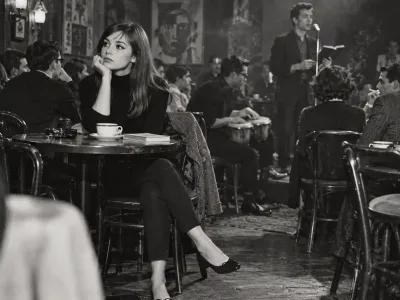
Almost everything on this site about the 1950s is about more: more skirt, more petticoat, more structure, more matching. Beatnik style is about less, and that's what makes it so interesting. It was one of the first real anti-fashion looks of the postwar years, and it pointed straight toward the 1960s.
The name comes from the Beat Generation, the group of American writers and poets around Jack Kerouac, Allen Ginsberg, and William S. Burroughs. Kerouac's On the Road came out in 1957, and in 1958 a San Francisco newspaper columnist coined the word "beatnik" for the young people who were copying the Beats' attitude - and their clothes. There was a strong European influence too: the existentialist cafés of Paris's Left Bank, where singers like Juliette Gréco dressed in black from head to toe, had been setting that tone since the late 1940s.
For women, the look was a clear rejection of the New Look. Instead of a nipped waist and a full skirt, there was a black turtleneck or loose sweater, black tights or a leotard, slim trousers or a straight skirt, and flat ballet shoes or sandals. Hair was long and straight, or cut short and simple, rather than set; make-up was pale, with heavy black eyeliner. There were no petticoats, no girdles on show, no matching accessories. It was cheap, practical, and deliberately plain, suited to people who spent their time in coffee houses, jazz clubs, and bookshops rather than at cocktail parties.
Mainstream culture found it fascinating and slightly ridiculous. The beatnik became a stock character in films, cartoons, and TV, complete with bongos and a beret. The most famous fashion moment is Audrey Hepburn's black outfit and dance in a Paris basement café in Funny Face (1957), which turned the look into something chic. But I think it matters much more than that. In a decade defined by conformity and careful dressing, beatnik style made "not trying" into a statement. The black turtleneck, the slim trousers, and the flat shoe all went on to become basics of 1960s youth fashion, which is a big legacy for a look that set out to ignore fashion altogether.