The Victorian Era Late Victorian / early Gibson Girl (1890s)
The Shirtwaist Blouse
A tailored blouse with a high collar and full sleeves, worn tucked into a plain skirt - mass-produced, affordable, and the working uniform of the 1890s 'New Woman'.
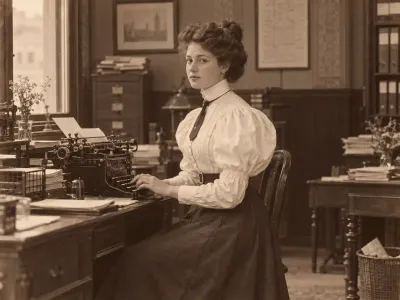
If one garment sums up the change in women's lives at the end of the Victorian era, I'd choose the shirtwaist. It's a simple blouse, worn with a separate skirt, but it represents a whole new way of dressing - practical, affordable, and made for women who went out to work.
"Shirtwaist" was the American name, and "blouse" the more common British one, for a bodice made separately from the skirt and styled somewhat like a man's shirt. The classic 1890s version had a high, stand-up collar, often stiffened and sometimes detachable, a buttoned front, and very full sleeves, which reached their largest "leg-of-mutton" size in the mid-1890s. It was often pleated or tucked across the front, and it was tucked into a plain, gored skirt at the waist, usually with a belt. Everyday versions were in white or striped cotton, while dressier ones came in silk and lace.
What made the shirtwaist so important was that it separated the top half of an outfit from the bottom. Earlier Victorian dresses were usually made as matching bodice and skirt, cut and fitted together. With a shirtwaist and skirt, a woman could own one or two skirts and several blouses, wash the blouses often, and mix them for variety. It was a much cheaper and more practical wardrobe - and it's the direct ancestor of the modern idea of separates.
It was also one of the first women's garments to be mass-produced on a huge scale. Its fairly loose fit and simple construction suited factory production, and department stores and mail-order catalogues sold them in enormous numbers at low prices. That made the shirtwaist the uniform of the growing number of women working as clerks, typists, shop assistants, and teachers, and of the idealised Gibson Girl, who was often drawn wearing one. Worn with a tailored jacket and skirt, it made a respectable, businesslike outfit.
The shirtwaist also has a darker history. It was made in crowded sweatshops, and in 1911, a decade after Victoria's death, the fire at New York's Triangle Shirtwaist Factory killed 146 workers, most of them young immigrant women, and became a turning point in labour reform. I think it's important to remember both sides: the shirtwaist gave women a practical, modern way to dress, and it was often made in terrible conditions by other women.