The Victorian Era Crinoline era (1850s–1860s)
The Paisley Shawl
Huge woven or printed shawls with the teardrop 'boteh' motif, imitating the Kashmir shawl - the one outer garment that could cover a crinoline, and a prized possession until the bustle made it impractical around 1870.
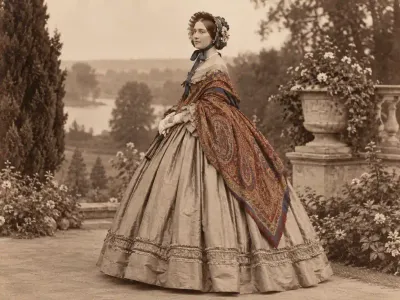
For much of the early and mid-Victorian period, the most prized item in a woman's wardrobe might not have been a dress at all, but a shawl. And the most famous shawls of the era are named after a Scottish town that never invented the design.
The story starts in Kashmir, where shawls of extremely fine goat hair were woven by hand in intricate patterns. The best-known motif is the boteh, a curved teardrop or pine-cone shape. Employees of the East India Company brought these shawls back to Britain in the late eighteenth century, and they became hugely fashionable - and hugely expensive. Weavers in Norwich, Edinburgh, and then Paisley, near Glasgow, started making cheaper imitations. Paisley came to dominate the trade, especially once it adopted the Jacquard loom, which could weave complex patterns automatically, and printed versions made the look cheaper still. By the Victorian era, the town's name had become the name of the pattern itself.
The shawl was perfectly suited to the crinoline era. When skirts grew enormous over the cage crinoline, fitted coats became awkward or impossible - a coat would have to be as wide as the skirt beneath it. A shawl simply went on top. The largest could be over three metres long, folded and draped around the shoulders so they fell in a point at the back over the skirt. Wearing one well was a skill in itself, and it displayed your taste and your means: a genuine Kashmir shawl was a luxury, while a Paisley or printed version was a more affordable version of the same status symbol. Shawls were popular wedding gifts, and were often handed down.
The fashion ended fairly abruptly around 1870, when the silhouette moved on to the bustle. A big shawl draped at the back would simply hide and flatten the bustle, which was the whole point of the new look, so fitted jackets, mantles, and dolmans took over. Cheap copies had also taken some of the prestige away. Many shawls ended up reused as tablecloths, piano covers, or bedspreads, which is partly why so many survive today. I think the Paisley shawl is a lovely example of how global Victorian fashion really was - an Indian textile, copied in Scotland, worn over a French-inspired silhouette - and of how a single change in shape can make a beloved garment obsolete almost overnight.