The Victorian Era Victorian era, broadly
Button Boots
Close-fitting ankle boots fastened with a long row of tiny buttons and a buttonhook - alongside elastic-sided and laced boots, the everyday footwear of Victorian women, and increasingly visible as hems rose.
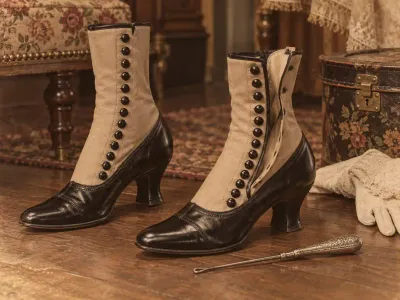
Victorian women's shoes usually vanish under long skirts in photographs, so they're easy to forget. But what a woman wore on her feet mattered a great deal, and for most of the era the everyday answer outdoors was a boot - very often a close-fitting ankle boot fastened with a long row of small buttons.
Early in Victoria's reign, fashionable women wore very light, flat, slipper-like shoes indoors and thin-soled boots outdoors, often with cloth uppers. Over the following decades, boots became sturdier and heels came back, growing to a modest, often curved heel by the later part of the century. Three main fastenings competed. Laced boots, often laced at the side early on, were practical. Elastic-sided boots, made possible first by covered coiled-wire gussets and soon by India-rubber elastic webbing, and associated with the London bootmaker J. Sparkes Hall, who promoted them to the young Queen Victoria, slipped on and off easily - the ancestor of the Chelsea boot. And button boots, fastened with a row of small buttons up the side or front, gave the neatest, closest fit, especially popular in the later decades.
A button boot was fitted like a glove, and it came with a similar ritual. Doing up a dozen or more tiny buttons by hand was fiddly, so women used a buttonhook - a small hooked tool that pulled each button through its hole. Buttonhooks, often in silver or with decorative handles, were everyday objects in Victorian homes, and many survive. The effort involved echoes the precision of gloves, another accessory where a close fit signalled refinement - and, for wealthier women, a lady's maid often did the buttoning.
Boots came in black or bronze leather, sometimes with cloth or suede upper sections in grey, fawn, or a colour matching the dress. As the century went on, and especially in the 1890s, walking skirts and tailor-made suits became shorter, clearing the ground for practical reasons, and boots became much more visible. A neat, well-polished boot was now part of the outfit, and cycling, walking, and sport all needed sturdy footwear. I love button boots as a small everyday detail of Victorian life: a little bit of daily effort, a lot of neatness, and a reminder of how many small rituals went into being properly dressed.