The Victorian Era Late Victorian (1875–1901)
Liberty Art Fabrics
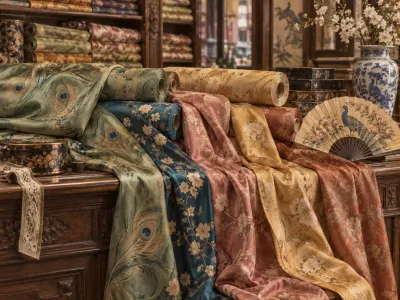
Soft Eastern silks and printed cottons in muted 'art colours' - sage, peacock, terracotta - sold from Arthur Liberty's Regent Street shop from 1875, and the fabric of choice for the Aesthetic set.
The dress reform entry covers the Aesthetic movement's argument against corsets and crinolines. This entry is about the fabric that made the look possible, because Aesthetic dress wasn't only a different shape - it was a different colour palette and a different feel, and much of that came from one London shop.
Arthur Lasenby Liberty had spent years managing an "Oriental warehouse" on Regent Street, selling goods from Japan, China, and India, and in 1875 he opened his own shop nearby, called East India House, with a small loan. At first it sold imported silks, ornaments, and decorative objects, and it caught the fashion for all things Japanese at exactly the right moment. Artists and designers were among its earliest and most loyal customers.
The key to Liberty's fabrics was colour. Mid-Victorian fashion was full of the bright, sometimes harsh shades produced by the new aniline dyes - mauve, magenta, acid greens. Liberty offered the opposite: soft, muted "art colours" like sage green, olive, peacock blue, old rose, saffron, and terracotta. Many of the silks were imported undyed from the East and then dyed and printed in England, notably by the Staffordshire dyer Thomas Wardle, who worked on reviving traditional natural dyes. The silks themselves were soft and light, very different from the stiff, heavy silks used for fashionable bodices. They draped and gathered in loose folds, which suited the flowing, uncorseted gowns the Aesthetic set wanted.
The look was famous enough to be mocked. Gilbert and Sullivan's comic opera Patience (1881) satirised the Aesthetes, with their languid poses and "greenery-yallery" clothes, and Liberty fabrics were used in the production. In 1884 the shop opened its own costume department, under the architect and designer E. W. Godwin, selling Aesthetic gowns and later tea gowns to a wider market. By the 1890s Liberty was also selling printed cottons and silks designed by Arts and Crafts designers, and its style became so identified with Art Nouveau that in Italy the movement was called stile Liberty. I love that a shop could be so influential. For many women, buying a length of Liberty silk was the easiest way to take part in the Aesthetic movement - no manifesto required, just a different taste in colour and cloth.