The Victorian Era Crinoline era onward (from 1860)
Paper Patterns and Butterick
Before the 1860s, home dressmakers copied fashions from tiny diagrams and overlapping pattern sheets; Ellen Demorest's full-size tissue-paper patterns and Ebenezer Butterick's graded sizes changed that for good.
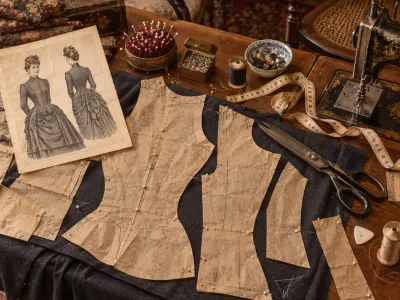
As someone who sews, this is the entry I find most personally interesting. A huge proportion of Victorian clothes were made at home or by local dressmakers, and the question of how those women got a fashionable pattern is surprisingly important. For much of the century, the answer was: with difficulty.
Before the 1860s, fashion magazines like Godey's Lady's Book printed fashion plates and occasional pattern diagrams, and some published pattern supplements. These were often small diagrams that had to be enlarged by hand, or large sheets with the pieces for several different garments printed on top of each other in different kinds of lines, which you had to trace out carefully. And they usually came in one size only. Adapting them to an individual figure needed real skill, so a good dressmaker - or a very experienced home sewist - was essential.
The first big change came from the Demorests in New York, Ellen Curtis Demorest and her husband William, who from around 1860 sold full-size tissue-paper patterns, promoted through their fashion magazines. The second, and more lasting, came from Ebenezer Butterick, a tailor in Massachusetts. In 1863, with his wife Ellen, he began selling paper patterns in a range of graded sizes (soon made of lightweight tissue) - first for men's shirts and boys' suits, and soon for women's clothes. The idea was simple but revolutionary: choose your size, pin the pieces to your fabric, and cut. Butterick's business grew fast, with its own fashion magazine, The Delineator, from 1873, and other firms like McCall's followed.
Combined with the spread of the home sewing machine, sized patterns made fashionable dress far more accessible. A woman in a small town could make something close to the latest style without paying a skilled dressmaker. This matters for understanding class and dress: the gap between how the wealthy and the middle classes looked narrowed noticeably in the late century, and paper patterns were part of the reason. I also love that the basic system - a printed envelope, tissue pieces, and a size chart - is still the one I use today. It's one of the Victorian inventions that never went away.