The 1970s 1970s
The Safari Jacket
A belted, many-pocketed jacket in khaki or sand-coloured cotton, borrowed from military and colonial bush clothing - turned into high fashion by Yves Saint Laurent's late-1960s 'saharienne' and worn by women and men alike through the decade.
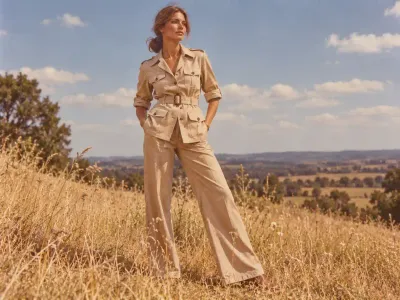
The safari jacket comes up briefly in the Yves Saint Laurent and Annie Hall entries, but it's one of the most important women's garments of the decade in its own right. It's also one of the best examples of 1970s fashion borrowing from menswear and from functional clothing.
The design is practical at heart. A classic safari jacket is made of lightweight cotton drill or gabardine, usually khaki, sand, olive, or white, and it has four patch pockets with buttoned flaps (two on the chest, two at the hips), shoulder epaulettes, a belt at the waist, and long sleeves, often rolled up, or short ones. It came from the "bush jackets" worn by soldiers and by European travellers and hunters in hot climates, especially in Africa and India, from the late nineteenth and early twentieth centuries. That background is part of its image, and it's worth being aware of its colonial associations as well as its practicality.
The fashion moment came in the late 1960s. Yves Saint Laurent had shown safari jackets - his saharienne - in his 1967 collection, but it was a laced-up version made for a 1968 Vogue Paris shoot that made it an icon. Franco Rubartelli's photograph of the model Veruschka in it turned the saharienne into a symbol of a new kind of woman: adventurous, confident, and comfortable in clothes borrowed from men. Through the 1970s the style spread everywhere, from designer versions to cheap high-street copies. Women wore safari jackets with matching trousers as a safari suit, with skirts, and with jeans, and there were safari dresses and jumpsuits too.
I think the safari jacket fitted the decade so well because it offered a kind of casual authority. For women increasingly going out to work, it was smart without being stiff or formal, and practical without being dull. It also matched the 1970s love of separates and of travel and adventure imagery. Men wore safari suits too, which made it one of the decade's genuinely shared styles. It's still a perennial summer classic today, and nearly every revival of it points back to Saint Laurent's 1968 version.