The 1970s mid-to-late 1970s
Qiana and Disco Nylons
DuPont's silk-like luxury nylon, launched in 1968 - the slinky, printable fabric behind many of the decade's disco shirts and clinging dresses, and a very different thing from the double knit it's often confused with.
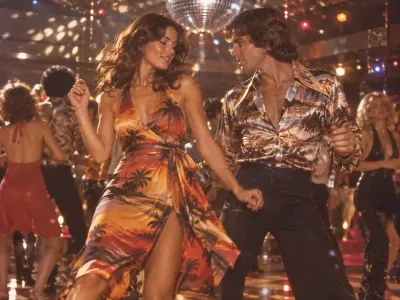
When people picture 1970s disco clothes, they often picture a shiny shirt with a huge collar and a wild print, and assume it's cheap polyester. Quite often, it's actually Qiana, which was marketed as the opposite of cheap - a luxury synthetic meant to rival silk.
Qiana was introduced by DuPont in 1968. It was a new kind of nylon, engineered to have a silky feel, a soft sheen, and a fluid drape, while being much easier to care for than real silk: it washed well, dried quickly, and resisted wrinkles. DuPont promoted it as a premium fibre, working with fashion designers and running glossy advertising, and it was priced accordingly. It's a good reminder that in this era synthetics weren't automatically seen as second-rate. Plenty of people saw them as modern and sophisticated.
Qiana was especially popular in knitted form, as a slinky, clinging jersey. That made it ideal for the body-skimming disco silhouette: it moved with the dancer, caught the light, and didn't crease however much you danced. It also printed brilliantly, taking bright colours and very detailed designs. That's where the famous disco shirt comes in - men's and women's shirts with enormous pointed collars, printed all over with photographic scenes, landscapes, or bold geometrics. Qiana was used for dresses, blouses, wrap dresses, and eveningwear, often in bold prints or rich solid colours.
It's worth separating Qiana from polyester double knit, which has its own entry. Double knit is thick, firm, and stable - the leisure suit fabric - while Qiana is thin, soft, and drapey, closer to silk jersey in feel. As disco went mass-market in the late 1970s, cheaper polyester knits imitated the Qiana look, and that flood of imitations is probably why the whole category got a tacky reputation. I think that's a bit unfair. Good Qiana pieces still feel lovely, the prints can be extraordinary, and they tell you a lot about how the decade saw synthetics - not as a substitute, but as the future.