The 1970s early-to-mid 1970s
Glam Rock
Glitter, satin, lurex and towering platforms on male rock stars - the British music scene of 1971-75 that made gender play mainstream TV entertainment, and handed its wardrobe straight to the audience.
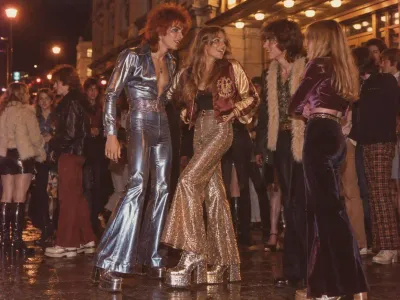
Glam rock pops up in passing all over the 1970s section - in platform shoes, in the jumpsuit, in the background of punk - so it's time it had its own entry. For a few years in the early part of the decade, it was the most visually outrageous thing on British television, and its clothes spread far beyond the stage.
It started around 1971, when Marc Bolan of T. Rex appeared on the BBC's Top of the Pops with glitter on his cheekbones and a satin jacket, and it was fully formed by 1972, when David Bowie introduced his Ziggy Stardust character. Roxy Music, Slade, and Sweet followed, each with their own version. The look was theatrical and deliberately artificial: skintight satin and lurex jumpsuits, glitter, sequins, feather boas, heavy make-up, dyed hair, and very high platform boots. Bowie's stage wardrobe included asymmetric knitted and printed bodysuits by the Japanese designer Kansai Yamamoto and sharp suits by the tailor Freddie Burretti, which shows how seriously the best of it took clothing.
What made glam culturally important was the gender play. Male stars wore make-up, satin, and platforms, and looked unmistakably glamorous doing it - on prime-time TV, in front of an audience of teenagers. It turned androgyny from something marginal into mainstream entertainment. And the fans copied it. Teenage boys and girls alike went out in glitter, satin, star-shaped face paint, bell-bottoms, and the highest platforms they could walk in. For young women, glam fed into a shiny, playful, dressed-up style that sat alongside the softer bohemian look of the early decade, and designers like Zandra Rhodes moved in the same flamboyant world.
By about 1975, glam was fading - it had become commercial, even cartoonish - and it was replaced by two very different reactions. One was punk, which took glam's shock value and theatricality but threw out the glitter in favour of ripped, safety-pinned anti-glamour; many early punks had been glam fans. The other was disco, which took the sparkle, the platforms, and the lamé onto the dance floor. I like glam rock as a hinge: it links the 1960s' dressing-up and gender experiments to both of the big late-1970s styles, and it proved that pop music could set fashion as fast as any designer.