The 1960s throughout the 1960s
Vidal Sassoon and the Geometric Cut
At the start of the decade, fashionable hair meant the lacquered, backcombed beehive; by the middle, Vidal Sassoon's sharp, wash-and-wear bobs had ended the weekly salon set - and matched the clean lines of mod clothes.
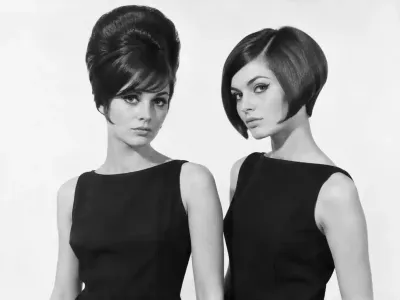
Hair tends to get left out of 1960s fashion histories, which I think is a real gap, because the decade's hair changed as dramatically as its hemlines - and for many of the same reasons. The best way to see it is to put two styles side by side: the beehive at the start of the decade and the Sassoon bob in the middle.
The beehive was big, high, and rounded, built up from the crown into a dome. It was created by a Chicago hairdresser, Margaret Vinci Heldt, in 1960 for a magazine competition, and it spread quickly across America and Britain. Getting it required backcombing (teasing the hair into a dense tangle for volume), careful smoothing over the top, lots of pins, and a thick coat of hairspray. Women slept carefully to preserve it and went back to the salon every week to have it redone. It fit perfectly with the polished, grown-up glamour of the Jackie look and the early 1960s generally.
Vidal Sassoon, a London hairdresser, thought all of that was a waste of time. His idea was that hair should be cut so precisely that its shape came from the cut itself, not from rollers and lacquer. You could wash it, shake it, and it would fall back into place. His famous cuts were sharp, graphic, and asymmetric: in 1963 a short, angular bob for the actress Nancy Kwan, then a geometric bob for Mary Quant, and in 1964 the "five-point cut," with its points shaped at the nape. These looked like architecture - which was the point.
What I love about this is how closely hair and clothes moved together. The clean-lined shift dress and the mini skirt needed a head to match, and a sleek, geometric bob gave the whole mod silhouette its crisp outline. It also fit the youthquake mood: a style you didn't have to sit under a dryer for every week was freeing, practical, and modern, and it made the carefully set hair of their mothers look instantly dated. Short cropped hair, like Twiggy's, followed the same logic. By the end of the decade the hippie look had swung back to long, natural, loose hair, but Sassoon's precision cutting stayed, and much of modern hairdressing is still built on it.