The 1950s 1950s
The Waspie and the Merry Widow
The short, boned waist cincher and its longer, strapless cousin - the foundation garments that made the New Look's tiny waist possible on real bodies.
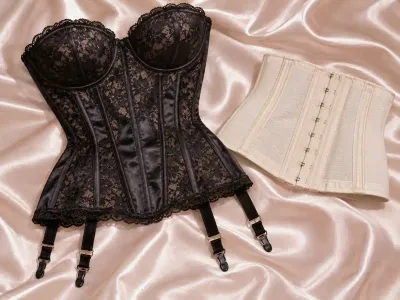
The New Look asked for something most women's bodies simply don't do on their own: a tiny waist, sharply defined, between a full bust and a full skirt. The dress could only do some of that work. The rest was done underneath, by a new generation of foundation garments that were, in effect, the corset quietly coming back after a few decades away.
The simplest was the waist cincher, also called a waspie (the English cousin of the French guêpière, from guêpe, "wasp"). It's a short, boned band that goes around the waist only, usually a few inches deep, fastened with hooks or laces, and often made of firm elastic with boned panels. The French couturier Marcel Rochas is usually credited with introducing the guêpière in the 1940s, and it suited the postwar mood perfectly. Under a full skirt, a waspie pulled in the waist by a couple of inches, and because the skirt covered the hips, nobody needed to see how it was done. Dior's 1947 collection relied on exactly this kind of cinching underneath.
The longer version was the Merry Widow, introduced by the American company Warner's in 1952 and named after that year's film of The Merry Widow starring Lana Turner. It was a strapless, boned corselette running from bust to hip, often with a built-in bra and suspenders for stockings. It smoothed the whole torso, lifted the bust, and nipped the waist at once, which made it ideal under strapless evening dresses and tight sheaths. Its name became shorthand for the whole category, and it was hugely popular with brides and for formal wear.
What I find interesting is how these garments were made compared with a Victorian corset. They used the new synthetic materials of the decade - nylon power-net, elastic panels, lighter spiral steel or plastic boning - so they were lighter and more flexible than the old versions, even if they still weren't comfortable. Combined with the bullet bra above and petticoats below, they created the whole 1950s shape as a layered system, with the dress sitting on top. It's a useful reminder that the famous 1950s hourglass wasn't a natural figure: it was a construction project, and a lot of it happened out of sight.