The 1930s early 1930s
Art Deco and Geometric Prints
Zigzags, sunbursts, stepped shapes and stylised flowers - the decorative language of Art Deco carried over from the 1920s onto 1930s dress fabrics, before softer florals took over mid-decade.
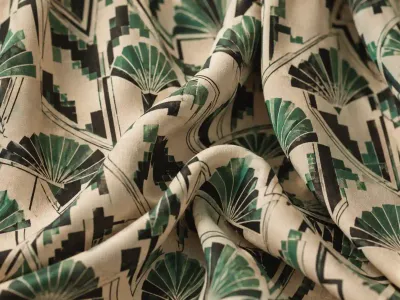
Art Deco is usually associated with buildings - the Chrysler Building, cinema façades, ocean liner interiors - but its bold, geometric style ended up printed on an enormous number of dresses too. For me, the prints are where you can see the 1930s holding onto the 1920s most clearly, even as the silhouette itself was changing completely.
The style takes its name from the 1925 Paris exhibition of decorative and industrial arts, and its visual vocabulary was well established by the end of that decade: zigzags and chevrons, sunbursts and fans, stepped "skyscraper" shapes, circles and arcs, and flowers flattened and simplified into geometric forms. Artists had been working directly with textile firms for years - Raoul Dufy's woodblock designs for the Lyon silk house Bianchini-Férier, and Sonia Delaunay's colourful, interlocking "simultaneous" fabrics, are the famous examples - and their ideas trickled down into mass-market printed cloth.
By the early 1930s, that trickle had become a flood, largely because of cheap printed rayon crepe. Rayon took print well, draped softly, and cost far less than silk, so an ordinary woman could own a dress in a crisp geometric pattern that looked modern and fashionable. You see Deco motifs on afternoon dresses, on beach pyjamas, and even, in cheaper cotton, on house dresses. The scale of the patterns shifted too: many of the huge, graphic prints of the 1920s gave way to smaller, denser repeats that sat better on a fitted, bias-cut dress, where a big pattern would twist and distort as the fabric wrapped the body.
As the decade went on, taste softened. By the mid-1930s, small florals, polka dots, and cheerful "novelty" prints were overtaking hard geometry, and by the end of the decade the witty, dreamlike prints associated with surrealism were the fashionable edge. So I think of Deco prints as the early-1930s print story: modern, confident, and machine-age, the last big outing of the 1920s aesthetic on a new, longer, softer shape of dress. They're also one of the easiest ways to date a vintage dress - a crisp geometric on rayon crepe often points to the late 1920s or first few years of the 1930s.