The 1930s throughout the 1930s
The Cowl Neckline
Soft folds of fabric falling at the neckline or back, made possible by cutting on the bias - one of the signature details of 1930s eveningwear and blouses.
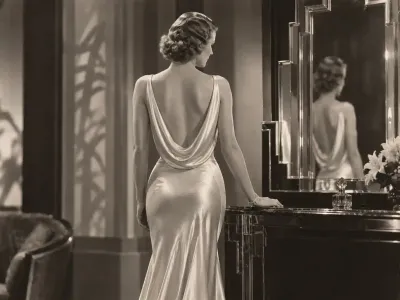
A cowl is a loose fold of fabric that falls in soft, curving drapes at the front neckline or down the back. It looks effortless, which is the point, but it only works because of a very specific cutting decision - and that's why it belongs so firmly to this decade.
The secret is the bias. Fabric cut on the straight grain is stable and stiff; hang a loose piece of it from two points and it just sags in a flat, awkward loop. Cut the same piece on the diagonal, and it becomes fluid and stretchy, so it falls into a series of rounded, even folds on its own. Vionnet, who did more than anyone to develop bias cutting, used cowls constantly, and once the bias-cut evening dress became the dominant look of the early 1930s, the cowl came with it.
The construction is simpler than it looks. Instead of cutting the neckline as a curve, the top edge of the bodice is extended upward and outward into a much wider shape, so there's extra length between the two shoulder points. That extra length is what falls into folds. The top edge is usually cut with its own facing folded back rather than finished with a seam, so there's no stiff edge to spoil the drape, and the depth of the cowl is controlled by how much length is added. Some dressmakers sewed a tiny weight or bead into the centre of the fold to make it hang evenly - a trick still used today. It also has to be made in the right fabric: silk satin, charmeuse, and soft crepe all hang beautifully, while anything crisp simply won't behave.
On the front of a dress, a cowl softens the bust and draws the eye up toward the face, which suited a decade that preferred a covered, modest front. On the back, it's even more dramatic: a deep back cowl on a backless gown falls low toward the waist, framing bare skin with fluid folds, which was very much the point in the Hollywood years. The same detail shows up on day blouses, too, in a milder form. For me it's the clearest example of how 1930s glamour was an engineering problem as much as an artistic one - that lovely, lazy drape is entirely down to grain and geometry.